Agentic AI Engineer
Orchestration systems for creative production
I design teams of AI agents with roles, approval gates and locks, built to cut redo rounds in creative production.
15 s ad for instant noodles. Retro Saigon, 1960s, charming humour.

7 timed panels with voice and sound cues.


Voice-over, music and foley as separate layers.
15 s master, 1080p.
Mechanisms
Why a team of agents
One prompt does not scale to real production. A system of agents does, as long as it is built with limits.
Approval before cost
Nothing expensive runs until a human has approved the route, the copy and the reference image. Wasted generations are reduced by design.
Lock and edit
Whatever is approved stays locked. Agents change only the marked area, so a fix does not restart the whole piece.
Repair, do not regenerate
Reuse what exists first. When a shot or an area fails, only that part is rebuilt, then everything is assembled in sequence.
Planned inside a budget
Work is planned inside a fixed monthly credit budget, so every generation has a reason and every retry is tracked.
These are design goals. Measured results will be added here once they exist.
Architecture
How the system is organised
A human directs. Agents work inside locks. Two gates stand in the way: one before cost, one before delivery.
- Brief and sources
- Lead agent
- Approval gate
- DesignVideo EditorLanding Builder
- QA gate
- Delivery
Proof
Case studies
Four systems, each written down from problem to lesson.
A user asks for a packaging design and a native ad banner. The Lead agent plans the route, the Creative Director approves it, the Design agent builds both, a QA gate checks them, and the banner and the packaging are delivered. The Video Editor and the Landing Builder are not needed for this brief.

A simulation of how I work with it. The sample product and its outputs are illustrative.
Agent team
Agentic AI
Creative Studio, a product I built: a small team of AI roles that takes a brief to delivery, with a human at every gate.
Read the caseAI agent
Node Studio Pro
A browser-based pipeline that turns a raw brief into a finished short ad through connected nodes.
Web build
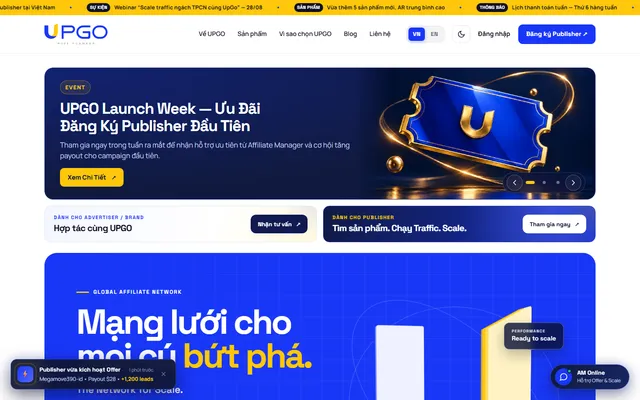
UPGO
A repeatable build workflow from a spreadsheet brief to a live landing page, with a live URL from the first rounds.

Concept studies
Video pipeline
A seven-step pipeline run three times on personal concept studies and logged down to the render.
Capabilities
What I can build and run
Design agent systems
Role design and orchestration
A small team of agents (Lead, Design, Video Editor, Landing Builder) moving a brief through eight stages.
Evidence: Agentic AIGuardrails and approval gates
Locks, separation of facts from hypotheses, and human approval placed before anything costly.
Evidence: Agentic AIBuild and control
Building agent tools
A seven-node pipeline in the browser with global state, Identity Lock for character consistency and safe fallbacks for failed shots.
Evidence: Node Studio ProStructured extraction
A model turns a raw script into clean JSON: scenes, characters, actions, voice and overlay text for the chosen market.
Evidence: Node Studio ProPrompt control
Strict rules that stop a model from inventing text, objects or products, and exact ordering of references.
Evidence: Video pipelineShip and verify
Evaluation and failure logs
Every render is versioned from V1 to V4 with its failure mode and the fix that followed.
Evidence: Video pipelineShipping to production
A live review loop, one commit per change, rollback instead of patching, and a published page at the end.
Evidence: UPGOCost and iteration control
A fixed credit budget, selective repair and a tracked count of every retry.
Evidence: Agentic AIHow this fits you
Hiring teams
You get an engineer who can own an agent system end to end: roles, orchestration, guardrails, QA, the tools around it and the cost of running it.
See the skillsClients
You get a documented pipeline with approval points that your own team can run, review and extend, instead of a black box.
See how it worksPartners
The system works around your existing assets: one source of truth, locked parts, and handover by market, language, format and version.
Get in touchHow we would work together
I sit with your team, trace how a brief becomes finished work today, and find where time and quality leak.
Stages, models, review points and fallbacks are drawn first, so every step has an owner and a way to fail safely.
I build the working pipeline and any custom agents it needs, then run it on a real brief of yours.
Your team learns to run, review and extend it, with notes on what to do when a stage fails.
History
Earlier work
Brand and digital work from 2016 to 2026, kept for reference. All of it was designed without AI.










Designer first, builder second
I am Vincent Bui, an Agentic AI Engineer. Before building agents I spent about ten years designing brand and digital work for VNPAY, Estee Lauder, California Fitness and UFC Gym.
That background shapes how I build: product facts, brand rules and human approval come first, and the agents work inside them. I document each system down to the stage, the model, the iteration and the lesson.
Tell me how your team works today.
A short email is enough: what you make, how often, and where it hurts.